
Afghans search for loved ones at rehab centre bombed by Pakistan, as dispute rages over target
- Global News News
Favour Chikwesiri Michael
- 0
- 5 minutes read
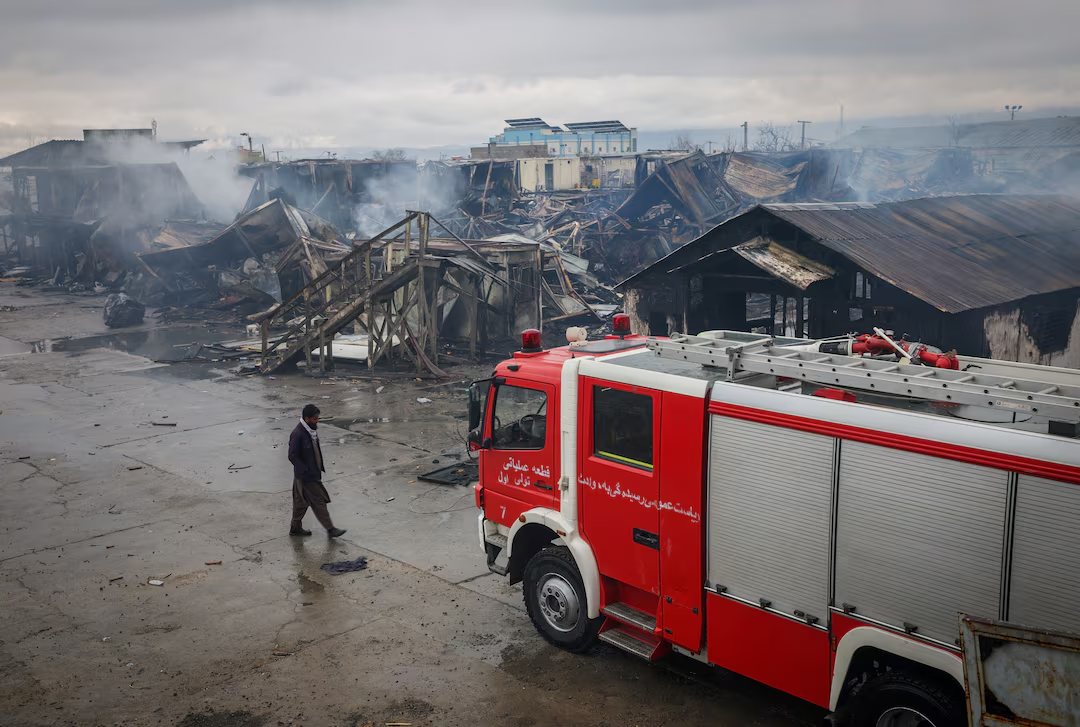
Families and friends of people undergoing treatment at a rehab centre in the Afghan capital Kabul searched for their loved ones on Wednesday, two days after it was bombed by Pakistan in the deadliest incident in the months-long conflict between the neighbours.
The Afghan Taliban government has said that more than 400 people were killed and 265 wounded in the air strike that took place on Monday night, just as people and staff at the centre were praying, days before the end of the holy month of Ramadan.
But the casualty numbers shared by authorities have not been independently verified. The United Nations Assistance Mission in Afghanistan told Reuters on Wednesday that 143 people were killed and 119 wounded in the attack.
Pakistan rejected the Taliban’s claims about the strike, saying it had “precisely targeted military installations and terrorist support infrastructure”.
The strikes mark a new low point in the relationship between the Islamic neighbours at a time of heightened instability for the region due to the U.S.-Israeli attacks on Iran.
Independent experts said it was challenging to establish the truth about the target in the face of the competing claims without a third-party investigation.
On Wednesday, relatives gathered at the site looking for their missing loved ones who were among the hundreds recovering there. Many said they did not know whether their relatives were alive or dead.
“We came here looking for our patient, he is missing,” said Mazar, 50, who gave only one name. “We checked the lists, but his name was not in the list of the living. Maybe he is injured or has been killed,” he said.
The Afghan interior ministry said funerals of some of those killed at the centre would take place later on Wednesday.
Afghan authorities said the attack had clearly targeted a well-known rehabilitation centre, a former NATO military base named Camp Phoenix that had been converted into a civilian facility about a decade ago.
Pakistan has said it hit Camp Phoenix, a “military terrorist ammunition and equipment storage site.” It added that secondary detonations visible after the strikes indicated the presence of large ammunition depots there.
The EU, UN agencies and international aid groups have said civilian and medical facilities should not be targeted during a conflict and called for immediate de-escalation.
“There are enough elements to confirm that this was a civilian facility that was hit,” said Jacopo Caridi, country director for aid group Norwegian Refugee Council in Afghanistan, adding that military infrastructure may have been located nearby. “They might have missed the objective, but the result is that civilians were killed or injured.”
Jennifer Brick Murtazashvili, a political scientist at the University of Pittsburgh and an Afghanistan expert, said it was plausible for civilian facilities to be located within or near former military sites in Kabul.
Adam Weinstein, deputy director of the Middle East program at the Quincy Institute in Washington, said misidentification of targets and the proximity of civilians to military targets were constant risks in an air war waged by Pakistan in dense urban areas.
He added it was a difficult intelligence-gathering environment and the Taliban was an opaque and reclusive government that ignores the norms of war.
The conflict between the allies-turned-foes began last year after Pakistan accused Afghanistan of sheltering and backing militants carrying out attacks across Pakistan, a charge denied by the Afghan Taliban government.
The conflict had ebbed amid efforts by friendly countries including China to mediate, but flared again with Pakistan directly targeting the Afghan Taliban last month and not just Pakistani Taliban militants Islamabad says are in the country.
“Pakistan is exasperated with dialogue and has made the decision to inflict pain on the Afghan Taliban,” Weinstein said. “But given the Taliban’s history that’s unlikely to change their position, so bigger strikes are likely.”
