
Brewers in India warn of shortages as Iran war hits glass bottle, can makers
- Global News News
Favour Chikwesiri Michael
- 0
- 5 minutes read
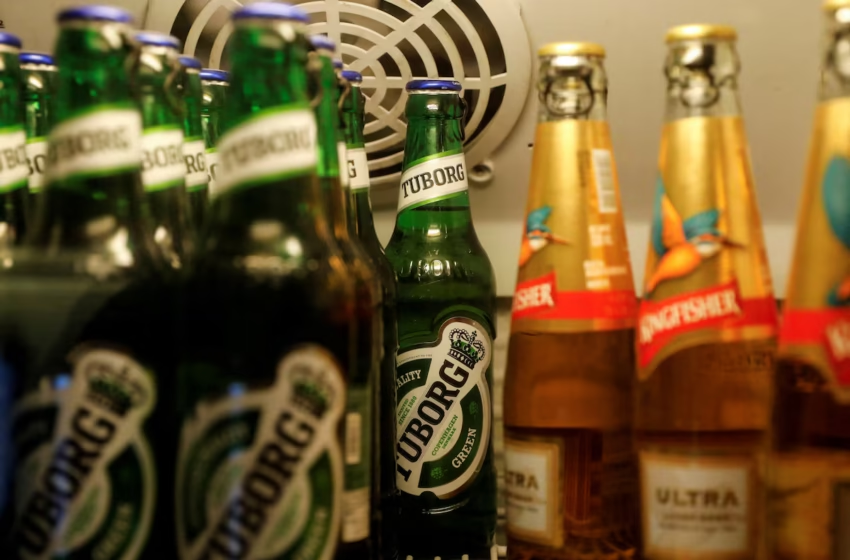
Global brewers operating in India are warning of price increases and supply disruptions as a shortage of gas due to the Iran war drives up the cost of glass bottles and shipping delays hit imports of aluminium needed by can makers.
India is especially vulnerable to fuel availability as the world’s fourth-largest importer of natural gas, relying heavily on the Middle East for shipments, sourcing about 40% of its supply from Qatar
Iranian attacks have partially disrupted Qatar’s export capacity, tightening gas availability for Indian manufacturers.
The Brewers Association of India, representing global brewers Heineken Anheuser-Busch InBev and Carlsberg told Newsmen that glass bottle prices have surged around 20%, paper carton rates have doubled as well as other packaging materials such as labels and tape.
Gas is essential to keeping furnaces and production lines running, and shortages have forced several glass bottle makers to partially or fully halt operations. Aluminium can suppliers have also warned of possible reductions just as India heads into its peak summer season, when beer sales typically rise.
“We are asking for price increases in the range of 12-15%,” the association’s director general Vinod Giri told Reuters. “We have advised our member companies to individually approach states.”
The rising cost of production is making some operations unsustainable, he added.
Heineken’s India unit United Breweries Anheuser-Busch InBev and Carlsberg did not respond to Reuters queries.
The market was worth $7.8 billion in 2024, and is expected to double by 2030, Grand View Research says. Heineken alone accounts for roughly half the market, while AB InBev and Carlsberg each account for 19%, the association said.
While the three companies dominate India’s beer sector, many smaller players such as Bira and Simba also operate in the market.
Beer and liquor sales in India have grown steadily alongside rising urbanisation and a young, increasingly affluent population.
The Confederation of Indian Alcoholic Beverage Companies, which represents many domestic companies, said it has written to several states seeking price adjustments to offset rising freight, logistics and input costs.
India’s alcohol sector is tightly regulated, and raising retail prices typically requires approval. Around two-thirds of India’s 28 states must authorise changes.
“Brewers may find it difficult to maintain supplies in states that do not allow price increases,” the association said.
Some glass bottle vendors are warning their clients of reduced supplies and have increased their prices.
Nitin Agarwal, CEO of Fine Art Glass Works in Firozabad, a glass-making hub in northern Uttar Pradesh state, said he has cut production by 40% at his glass bottle making factory due to gas shortages. His customers include many liquor companies as well as producers of juice and ketchup bottles.
“We’ve cut production and increased prices by 17-18%,” Agarwal said.
The shortages have already affected India’s $5 billion bottled water market with some producers increasing prices by 11% due to rising rates of plastic bottles and caps.
And there are signs the crisis is spreading.
An executive at Lotte Chilsung Beverage, one of the leading South Korean soft drinks companies, told Reuters that it has up to three months of inventory for plastic bottles and plastic materials.
“The situation is serious,” he said.
