
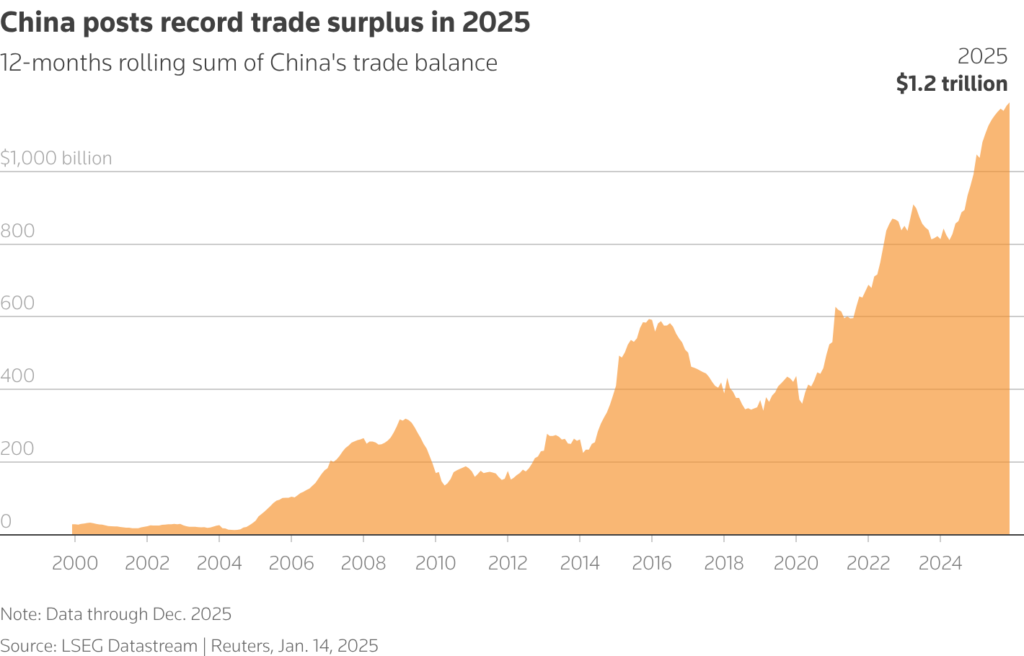
China closed out 2025 with a record $1.2 trillion trade surplus, shrugging off the impact of Trump-era tariffs.
- Global News
Favour Chikwesiri Michael
- 0
- 6 minutes read
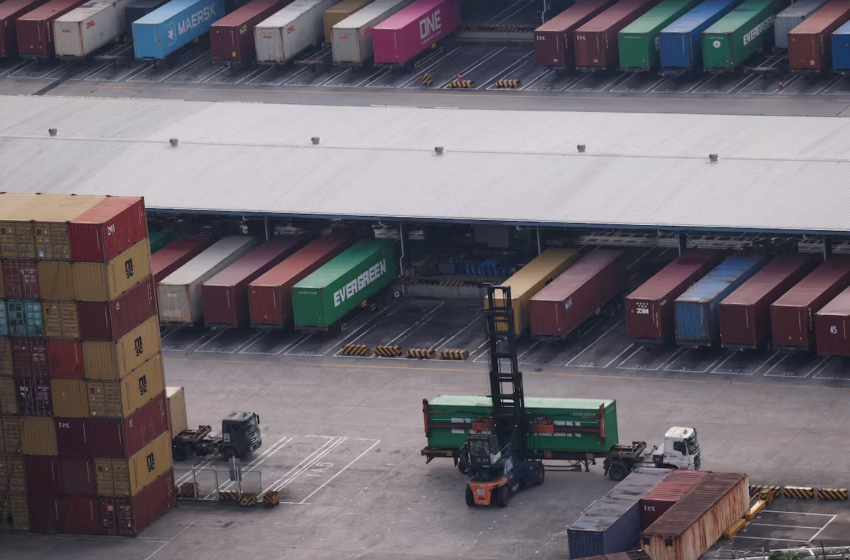
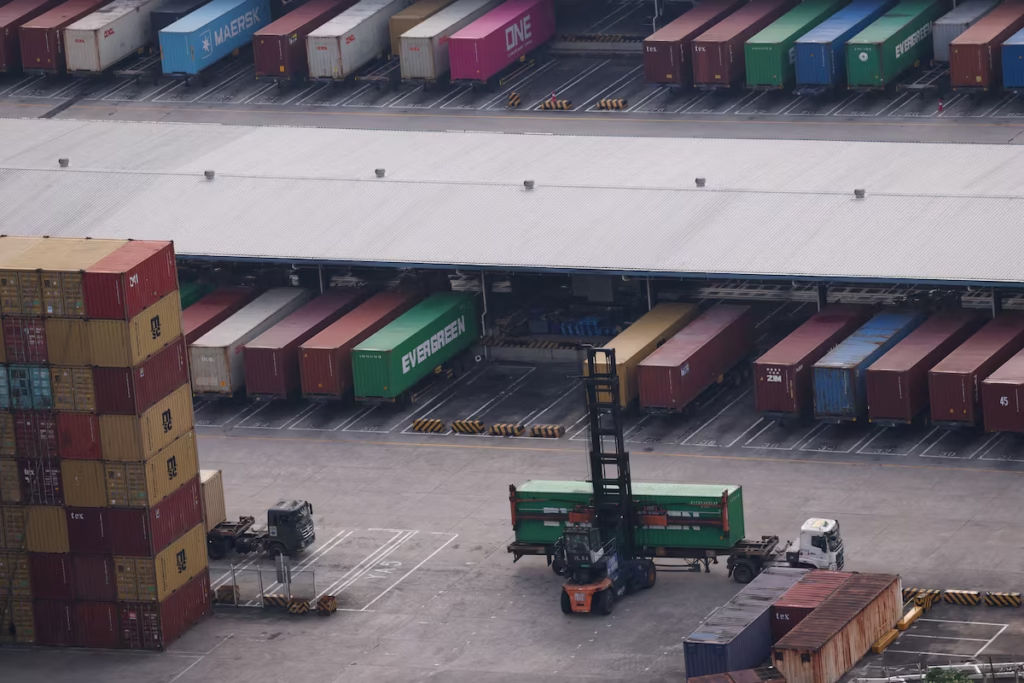
Yantian port in Shenzhen, Guangdong A container handler unloads a container from a truck at a terminal of the Yantian port in Shenzhen, Guangdong province, China October 30, 2025. REUTERS/Tingshu Wang/File
On Wednesday, China announced a record trade surplus of nearly $1.2 trillion in 2025, driven by soaring exports to non-U.S. markets as producers aimed to expand globally and counter ongoing pressure from the Trump administration.
Policymakers encouraged Chinese companies to look beyond the world’s biggest consumer market and expand into Southeast Asia, Africa, and Latin America, a move that paid off by helping shield the economy from U.S. tariffs and growing trade, technology, and geopolitical tensions since President Donald Trump returned to the White House last year.
Fred Neumann, chief Asia economist at HSBC, noted that China’s economy is still highly competitive. He explained that this comes not only from improved productivity and the growing technological sophistication of Chinese manufacturers but also from weak domestic demand and the resulting excess capacity.
As 2026 approaches, Beijing faces plenty of challenges, from easing growing concerns in global capitals over China’s trade practices and industrial overcapacity to addressing the heavy reliance on key Chinese products.
A big question for policymakers is how long the $19 trillion economy can keep offsetting a property slump and weak domestic demand by exporting increasingly cheaper goods to other markets.
Neumann noted that growing Chinese trade surpluses could spark tensions with trade partners, particularly those that also depend heavily on manufacturing exports.
The manufacturing giant’s annual trade surplus hit $1.189 trillion, matching the GDP of a top-20 global economy like Saudi Arabia, according to customs data released Wednesday, after surpassing the trillion-dollar mark for the first time in November.
“With a broader range of trading partners, China’s ability to handle risks has greatly improved,” said Wang Jun, vice minister at China’s customs administration, during a press briefing after the data release.
In December, outbound shipments from the world’s second-largest economy rose 6.6% in value year-on-year, up from a 5.9% increase in November. This growth beat economists’ expectations, as a Reuters poll had predicted only a 3.0% rise.
The manufacturing giant ended the year with a trade surplus of $1.189 trillion, matching the GDP of a top-20 economy like Saudi Arabia, according to customs data released Wednesday. It first crossed the trillion-dollar mark in November.
“With a wider range of trading partners, China’s ability to handle risks has improved greatly,” said Wang Jun, vice minister at China’s customs administration, during a press briefing after the data release.
In December, outbound shipments from the world’s second-largest economy rose 6.6% in value year-on-year, up from a 5.9% increase in November. This growth beat economists’ expectations, as a Reuters poll had predicted only a 3.0% rise.
China’s yuan held steady following the upbeat data, even as equity investors welcomed the forecast-beating numbers. The benchmark Shanghai Composite index and blue-chip CSI300 index both rose more than 1% in morning deals.
The Asian powerhouse economy’s monthly trade surpluses exceeded $100 billion seven times last year, partially underpinned by a weakened yuan, up from just once in 2024, underscoring that Trump’s actions have barely dented China’s broader trade with the wider world even if he has curbed U.S.-bound shipments.
