
Mogadishu Accuses Israel of Undermining Sovereignty After Hargeisa Visit
- Global News
 Otaria Benjamin
- 0
- 3 minutes read
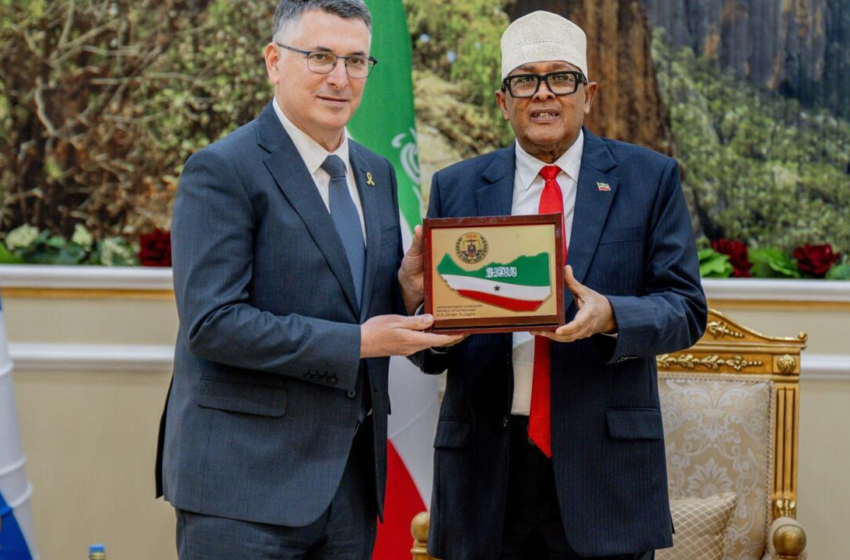
Somaliland’s President Abdirahman Abdullahi Mohamed (R) meets with Israel’s Foreign Minister Gideon Saar in the breakaway region’s capital, Hargeisa./AFP
Somalia’s federal government has strongly condemned the visit by Israel’s foreign minister to Hargeisa, Gideon Saar, describing it as a violation of the country’s sovereignty and territorial integrity, officials said on Tuesday.
In a statement on X, Saar said that he had held talks “on the full range of relations” with Somaliland’s president, Abdirahman Mohammed Abdullah, in the capital Hargeisa.
“We are determined to vigorously advance relations between Israel and Somaliland,” Saar wrote on X, alongside images of him meeting the Somaliland leader at the presidential palace.
In a statement, the Somali Ministry of Foreign Affairs said the visit by the Israeli official to the capital of Somaliland, a region that declared independence from Somalia in 1991 but remains internationally recognised as part of Somali territory, contradicts established principles of international law and regional stability.
Somalia reiterated its position that Somaliland remains an integral part of its sovereign territory and called on the international community to respect the nation’s borders. The government also urged global organisations to reject unilateral recognition of entities within existing states without a broad consensus.
The condemnation follows a recent decision by Israel to formally recognise Somaliland as an independent state and send its foreign minister on an official visit. The move has provoked diplomatic tensions and drawn criticism from several African and Middle Eastern governments.
Somali officials said they were coordinating responses with African Union partners and other regional blocs to uphold norms regarding sovereignty and non-interference. The government stressed its commitment to pursuing peaceful diplomacy while defending its territorial claims.
International reactions to the visit and recognition continue to unfold as governments and organisations assess the implications for regional security in the Horn of Africa.
SOURCE: Reuters
