
Pakistan has relayed a US proposal, with a senior Iranian official suggesting that either Turkey or Pakistan could host the talks.
- Global News News
Favour Chikwesiri Michael
- 0
- 7 minutes read
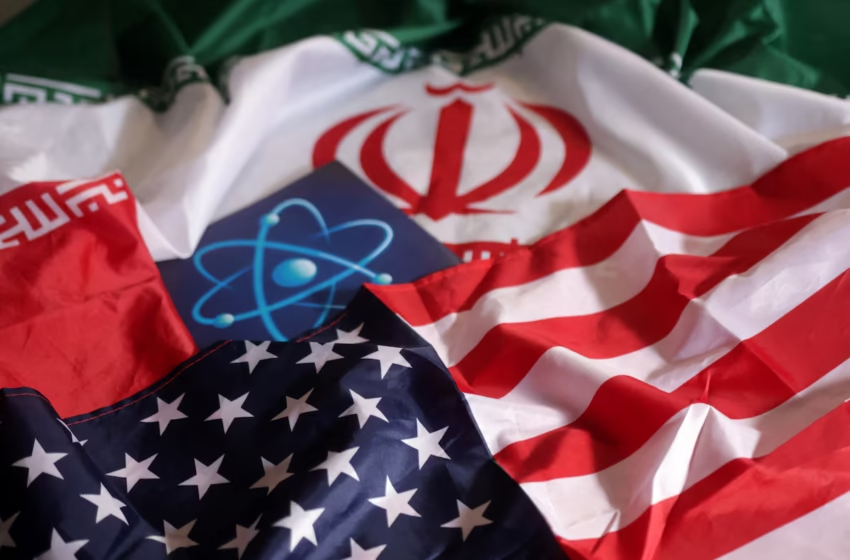
Pakistan has delivered a proposal from the United States to Iran, and either Pakistan or Turkey could be venues for discussions to de-escalate the war in the gulf a senior Iranian official told Reuters on Wednesday.
The comments, by an official speaking on condition of anonymity, were among the few signs that Tehran was willing to consider diplomatic proposals, despite having denied in public that it would negotiate with the administration of President Donald Trump.
The Iranian source did not disclose details of the proposal passed on by Pakistan, or whether it was the same as a 15-point U.S. proposal that has been reported by news outlets including Reuters. The source said Turkey had also “helped to end the war and either Turkey or Pakistan was under consideration as the venue for such talks”.
Oil prices fell and battered shares recovered on Wednesday after reports that the U.S. had sent the 15-point plan to Iran, with investors hoping for an end to nearly four weeks of war that has killed thousands and disrupted global energy supplies.
A source familiar with the matter had confirmed on Tuesday to Reuters that the plan had been sent to Iran.
Three Israeli cabinet sources said Prime Minister Benjamin Netanyahu’s security cabinet had been briefed on the proposal, which they said includes removing Iran’s stocks of highly enriched uranium, halting enrichment, curbing its ballistic missile programme and ending funding for regional allies.
Meanwhile, the Pentagon is preparing to deploy thousands of airborne troops to the Gulf, giving Trump more options for ordering a ground assault, according to sources cited by Reuters. This adds to two Marine contingents already en route, with the first Marine Expeditionary Unit aboard a massive amphibious assault ship expected to arrive by the end of the month.
But so far there has been no public recognition from Iran that it is willing to negotiate at all, while its assertions that it would not do so have become increasingly caustic.
“Has the level of your inner struggle reached the stage of you negotiating with yourself?” the top spokesperson for Iran’s joint military command, Ebrahim Zolfaqari, taunted Trump in comments on Iranian state TV.
“People like us can never get along with people like you,” he said. “As we have always said … no one like us will make a deal with you. Not now. Not ever.”
Iran’s foreign ministry spokesperson, Esmail Beghaei, appearing on television in India, noted that nuclear talks had already been under way when Trump attacked, which he called “a betrayal of diplomacy” that made further talks pointless.
There are “no talks or negotiations between Iran and the United States”, he said. “No one can trust United States diplomacy. Our position is clear on what they have claimed. Right now our brave military is focused on defending Iran’s territory and sovereignty against this brutal and illegal war.”
A senior Israeli defence official said Israel was sceptical Iran would agree to the terms, and that Israel was concerned that the terms were only starting points for negotiations, during which U.S. negotiators might make concessions.
A source familiar with Israel’s war plans said Israel wanted any U.S.-Iranian agreement to preserve Israel’s option to conduct pre-emptive strikes.
Trump, who early in the war had said it would end only with Tehran’s “unconditional surrender” and his choosing Iran’s leaders, has abruptly changed tack this week declaring that “productive” talks had been under way for days with unspecified Iranian officials.
His softer stance, which included abruptly postponing a threat to escalate the bombing by attacking Iran’s civilian energy system, caused a respite in financial markets, which have see-sawed but largely stabilised since Monday.
But Iran has consistently maintained that no such talks have taken place, and derided Trump’s announcement as an attempt to buy time and placate the markets.
Nearly four weeks into the war that has killed thousands, there was no let-up in air attacks against Iran, or in Iranian drone and missile strikes against Israel and U.S. allies.
The Israeli military said in a Telegram post it had launched a wave of strikes targeting infrastructure across Tehran. It later said its air force had struck two naval cruise missile production sites in Tehran.
The semi-official Iranian SNN News Agency said the strikes hit a residential area in the city, with rescuers searching the rubble.
Kuwait and Saudi Arabia said they had repelled fresh drone attacks. Drones targeted a fuel tank at Kuwait International Airport, causing a fire but no casualties, Kuwait’s Civil Aviation Authority said.
Iran’s Revolutionary Guards said they had launched a new wave of attacks against locations in Israel including Tel Aviv and Kiryat Shmona, as well as U.S. bases in Kuwait, Jordan and Bahrain, Iranian state media reported.
Since the start of “Operation Epic Fury” by the U.S. in February, Iran has attacked countries that host U.S. bases and effectively closed the Strait of Hormuz conduit for a fifth of the world’s oil and liquefied natural gas.
Iran has told the United Nations Security Council and the International Maritime Organization that “non hostile vessels may transit the Strait of Hormuz if they coordinate with Iranian authorities. In practice, however, only Iran’s own oil and a handful of ships from friendly countries have made it through.
