
Where is the Nigerian Social Contract?

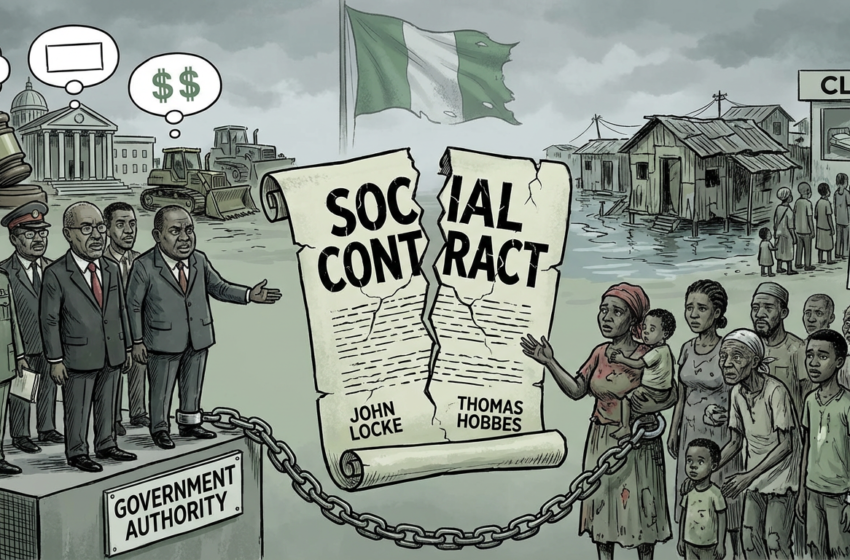
AI Image illustrating a torn contract.
Written by Chukwu C. Ikechukwu
I discussed with a very good friend. Our discussion veered into a discourse centred on governance in Africa, which we narrowed down to Nigeria.
Of particular concern is the way those who hold positions of authority and trust conduct themselves. Yes, those positions are held in confidence of the people, or at least, that is what it should be. But what we see most times is that these fellows, having assumed office, disregard the concept or theory of social contract as put forth by John Locke and Thomas Hobbes before him. Nigerian political leaders seem unaware of these theories or completely disagree with them. Worse is that Nigerian citizens seem equally unaware that they have a contractual agreement with their leaders. If only most of us knew, we probably would make demands in line with the social contract. And because the leaders are unaware or disagree with both Thomas Hobbes and John Locke, they have governed as slave masters while the people applaud them as benevolent slave drivers.
Two examples will suffice. Last week or so, a post purported to be an interview granted by a former military administrator in Lagos State went viral. The interview was on his “stewardship” in Lagos State. He had demolished a community of over 300,000 people because he and the then Head of State ran into armed robbers on that axis. He claimed the robbers attempted to attack them. If you understand how many security convoys these guys move with, you will understand that this is not likely true, but an attempt to give a dog a bad name to hang it. But what if it is true? Should the response be to punish the entire community over the government’s failure to provide security? Isn’t it the place of government to protect people’s lives and properties from criminals?
Recently, a waterfront community, Makoko, was demolished because the place is not fit for human habitation. That sounds cool, right? But the big question is, “What alternative provision did the government make?” NONE!!!
Between the December Christmas period and the last day of January, Nigeria, as at other times, has recorded avoidable deaths because of poor health care and emergency response systems or the non-existence of such. But in modern times, health care, housing, education, etc., are part of the social contract to which those who govern subscribe, and indeed should be the barest minimum. But because the citizens seem unaware and make no demand for the fulfilment of this contractual agreement, governments across the country can afford to demolish houses with no alternative. Health care remains imaginary as people die of snake bites in the best of our cities. When will this stop?
