
The US has started blocking Iran’s ports, and Tehran warns of strike back.
- Global News News
Favour Chikwesiri Michael
- 0
- 7 minutes read
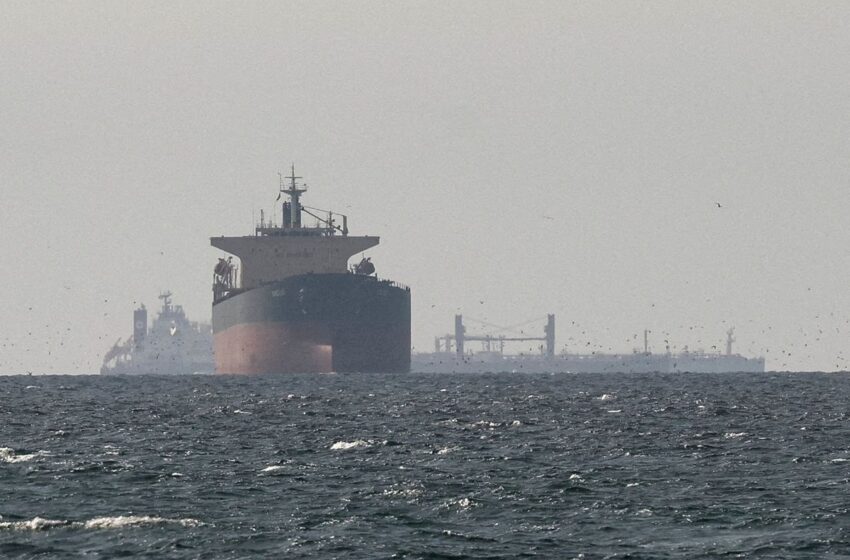
Cargo ships in the Gulf, near the Strait of Hormuz, as seen from northern Ras al-Khaimah, near the border with Oman’s Musandam governance, amid the U.S.-Israeli conflict with Iran, in United Arab Emirates, March 11, 2026. REUTERS
The U.S. military began a blockade of ships leaving Iran’s ports on Monday, President Donald Trump said, and Tehran threatened to retaliate against its Gulf neighbours’ ports after weekend talks in Islamabad on ending the war broke down.
A U.S. official said there was continued engagement with Iran, and forward motion on trying to get to an agreement. Pakistani Prime Minister Shehbaz Sharif also said efforts were still under way to resolve the conflict.
But oil prices climbed back over $100 per barrel, with no sign of a swift reopening of the Strait of Hormuz to ease the biggest ever disruption in supplies and broader concerns over the durability of a two-week ceasefire agreement reached last week.
Trump mentioned that Iran reached out on Monday expressing interest in making a deal, but he made it clear he wouldn’t approve any agreement that lets Tehran possess a nuclear weapon.
“Iran will not have a nuclear weapon,” Trump told reporters at the White House. “We can’t let a country blackmail or extort the world.”
Since the United States and Israel began the war on February 28, Iran effectively shut the Strait of Hormuz to all vessels except its own, saying passage would be permitted only under Iranian control and subject to a fee.
Trump stated that Washington would block Iranian vessels and any ships paying such tolls, adding that any Iranian “fast-attack” ships approaching the blockade would be destroyed.
Brigadier General Reza Talaei-Nik, a spokesperson for Iran’s Ministry of Defence, warned that foreign military efforts to police the strait would escalate the crisis and instability in global energy security.
NATO allies, including Britain and France, said they wouldn’t get involved in the conflict by joining the blockade, emphasizing instead the importance of reopening the waterway, which normally carries about one-fifth of the world’s oil.
The ceasefire that halted six weeks of U.S. and Israeli airstrikes looked in jeopardy, with only a week left to run. Washington said Tehran rejected its demands at weekend talks in Islamabad, the highest-level discussions between the two nations since Iran’s 1979 Islamic Revolution.
The U.S. military’s Central Command said the blockade would be “enforced impartially against vessels of all nations” entering or leaving Iranian ports in the Gulf and Gulf of Oman.
Central Command stated in a note to seafarers, seen by Reuters on Monday, that the blockade will not interfere with neutral transit through the Strait of Hormuz to or from destinations outside of Iran.
Two Iranian-linked tankers, the Aurora and New Future, left the strait laden with oil products on Monday before the deadline, according to LSEG data.
An Iranian military spokesperson called any U.S. restrictions on international shipping “piracy,” warning that if Iranian ports were threatened, no port in the Gulf or Gulf of Oman would be secure. Any military vessels approaching the strait would violate the ceasefire, Iran’s Revolutionary Guards said.
Trump said Iran’s navy had been “completely obliterated” during the war, adding that only a small number of “fast-attack ships” remained.
“Warning: If any of these ships come anywhere close to our BLOCKADE, they will be immediately ELIMINATED, using the same system of kill that we use against the drug dealers on boats at Sea. It is quick and brutal,” Trump, much of whose communications are on social media, wrote on his microblogging site.
He was apparently referring to the U.S. strikes carried out against suspected drug boats in the Caribbean and Pacific. The strikes, which began in September, killed more than 160 people. The U.S. military has not provided evidence that the vessels were ferrying drugs.
Trump has also lashed out at U.S.-born Pope Leo who has spoken out against the war, denouncing him as “terrible” in a rare direct attack by a U.S. president on a pontiff.
With the war unpopular at home and rising energy prices causing political blowback, Trump paused the U.S.-Israeli bombing campaign last week after threatening to destroy Iran’s “whole civilisation” unless it reopened the strait.
Israel has continued to bombard Lebanon and on Monday Israeli troops launched an attack it said was intended to seize a key south Lebanon town from Iran-backed Hezbollah. Israel and the U.S. have said the campaign against Hezbollah was not part of the ceasefire, while Iran has insisted it is.
The International Committee of the Red Cross said on Monday it was deeply concerned about attacks on medical workers in Lebanon after a deadly strike on a Red Cross center in the country.
Iran has brought new demands, including recognition of its control of the waterway, lifting of sanctions and the withdrawal of forces from U.S. military bases across the Middle East.
Trump has declared victory, despite failing to achieve the objectives he set out at the start of the war: to eliminate Iran’s ability to strike its neighbours, end its nuclear programme and make it easier for Iranians to topple their government.
Benchmark oil prices, which had eased last week after the ceasefire was announced, traded around 6% higher on Monday, off the day’s peaks but still above $100 a barrel.
Traders say the main benchmarks – used to set prices for trillions of dollars’ worth of commodities worldwide – actually understate the severity of a disruption with no precedent in modern times.
