
Ukrainian skeleton slider lamaents IOC has banned helmet despite its symbolism
- Global News Sports
Favour Chikwesiri Michael
- 0
- 5 minutes read
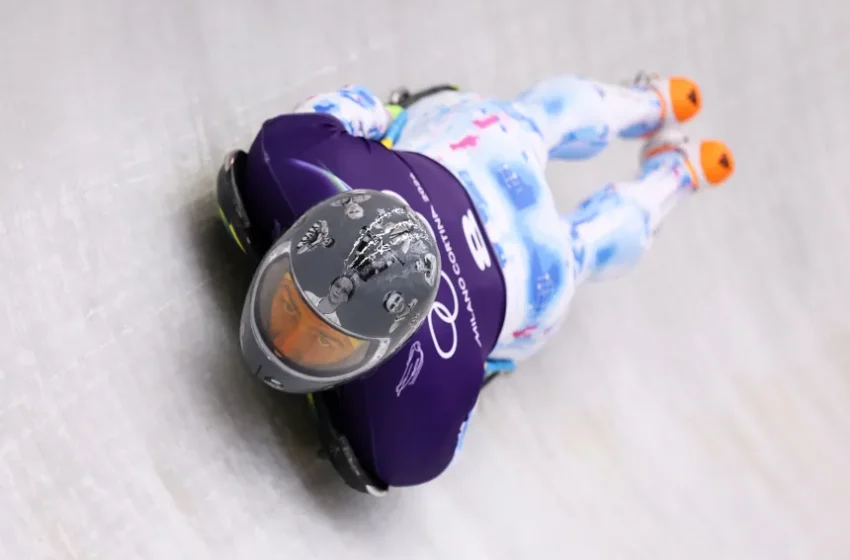
Vladyslav Heraskevych of Team Ukraine participates during Skeleton Men’s Singles training at Cortina Sliding Centre on Monday. Richard Heathcote/Getty Images
Ukrainian skeleton racer Vladyslav Heraskevych says the International Olympic Committee (IOC) has prohibited him from wearing a helmet decorated with images of athletes who were killed in the war in Ukraine.
The helmet was worn by the 27-year-old during a Winter Olympics skeleton training session in Cortina d’Ampezzo on Monday.
The athletes featured on the helmet are: weightlifter Alina Perehudova, boxer Pavlo Ischenko, ice hockey player Oleksiy Loginov, actor and athlete Ivan Kononenko, diver and coach Mykyta Kozubenko, shooter Oleksiy Habarov and dancer Daria Kurdel.
In a video shared on social media after his training session, Heraskevych — who carried his country’s flag at the opening ceremony — said that Toshio Tsurunaga, the IOC’s liaison for communications between athletes, national Olympic committees, and the IOC, had visited the Athletes’ Village to deliver the decision.
“A decision that simply breaks my heart. The feeling that the IOC is betraying those athletes who were part of the Olympic movement, not allowing them to be honored on the sports arena where these athletes will never be able to step again,” he says in the video.
“Despite precedents in modern times and in the past when the IOC allowed such tributes, this time they decided to set special rules just for Ukraine.”
Heraskevych later mentioned to Reuters that the IOC made its decision due to Rule 50.
Rule 50.2 of the Olympic Charter says that no demonstrations or any form of political, religious, or racial propaganda are allowed in Olympic sites, venues, or other areas.”
The IOC told CNN in an email Monday that: “To date, the IOC has not received any request from the NOC, for the athlete to wear the helmet in the competition. Once a submission is made, the IOC will look at the request.”
Ukraine’s Olympic Committee announced Tuesday that it had submitted a request to the IOC for Heraskevych to wear “a helmet of remembrance” at the Games.
“The helmet was created to honor Ukrainian athletes killed while defending Ukraine or who became victims of Russia’s full-scale war against Ukraine,” Ukraine’s Olympic Committee said in a statement.
“The NOC of Ukraine emphasizes that it fully complies with safety requirements and IOC rules, does not contain advertising, political slogans, or discriminatory elements, and was confirmed as meeting the established standards during official training sessions.”
CNN Sports approached the IOC again Tuesday to ask whether it had received the request.
Speaking to CNN ahead of the Games, the Ukrainian athlete promised to used the event as a platform to remind the world of Russia’s ongoing war in his homeland and hinted that protests could take place.
Ukrainian President Volodymyr Zelenskyy took to social media to commend Heraskevych for wearing the helmet, expressing gratitude for “reminding the world of the cost of our struggle.”
“This truth cannot be inconvenient, inappropriate, or called a ‘political demonstration at a sporting event.’ It is a reminder to the whole world of what modern Russia is,” Zelenskyy wrote.
“And this is what reminds everyone of the global role of sports and the historic mission of the Olympic movement itself – it is all about peace and for the sake of life. Ukraine remains faithful to this. Russia proves otherwise.”
The IOC has approved 13 Russian and 7 Belarusian athletes to compete as Individual Neutral Athletes in the Winter Games.
Four years ago at the Beijing Games, Heraskevych grabbed global attention by holding up a “No War in Ukraine” banner to protest the looming Russian invasion.
