
US, Iran Exchange Fire As Negotiations Stall
- Global News News
Favour Chikwesiri Michael
- 0
- 4 minutes read
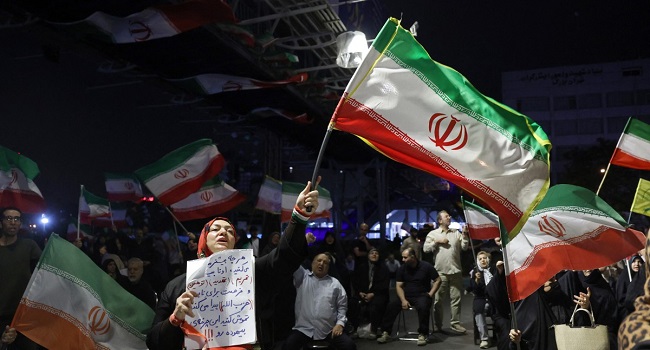
People wave Iran’s national flags during an anti-US and Israel protest in Tehran on May 29, 2026. Iran’s foreign ministry said on May 29 that there were “no negotiations” taking place on its nuclear programme, after US President Donald Trump suggested it would relinquish its enriched uranium under a deal to end the Middle East war. (Photo by AFP) /
The United States and Iran said Monday they had again traded strikes, straining an already fragile ceasefire as negotiations between the two sides have stalled.
Weeks of tough negotiations filled with heated rhetoric and occasional bursts of violence have failed to produce a deal to end the war and reopen the Strait of Hormuz, a vital route for oil supplies.
Washington and Tehran have sharp differences on questions like Iranian nuclear efforts and the fighting in Lebanon, which Iran has demanded must stop as part of a broader agreement.
The latest exchange of fire coincided with Israel expanding its offensive in Lebanon, with Prime Minister Netanyahu vowing to push deeper into the country.
The US military announced that it had carried out “self-defense strikes” on Iranian radar and drone control sites in the southern part of the country over the weekend — its third such wave in just over a week.
The strikes were in response to the downing of a US MQ-1 drone, it added.
Shortly after, Iran’s Revolutionary Guards said they targeted an “air base from which the attack originated” used by the US military, state broadcaster IRIB reported Monday, without specifying the location of the base.
The Guards’ announcement came on the heels of the Kuwaiti military saying its air defences intercepted “hostile missile and drone attacks”, without mentioning where attack originated.
Iran was already in talks with the United States about the fate of its nuclear programme in February when the US and Israel launched air and missile strikes that wiped out much of the Islamic Republic’s senior leadership.
While Tehran has long insisted that its nuclear programme is for purely civilian ends, the United States and its Western allies suspect it aims to develop a weapon.
The New York Times and Axios reported on Saturday that Trump had sent back a “tougher” new framework to be considered by Iran, though details remain unclear.
Trump has said his priorities include stopping Iran from developing any nuclear weapons and reopening the Hormuz shipping lane, which Iran has blockaded since the war began.
“The one guarantee that I have to have is that there will be no nuclear weapons. They’ve agreed to that, and it was very interesting,” he told his daughter-in-law, Lara Trump, in an interview on her Fox News show.
Late Sunday, Trump stressed on Truth Social that the proposed deal “states, very clearly, that Iran will not have a Nuclear Weapon”.
Tehran, however, has previously cast doubt on Trump’s assertions, and the sides remain far apart on key issues.
“We will not approve any agreement until we are certain that the rights of the Iranian people have been upheld,” Iran’s top negotiator Mohammad Bagher Ghalibaf said in a video broadcast on state television.
According to the Tasnim news agency, exchanges on the text “are ongoing, with both parties regularly proposing amendments”.
